does anyone else with intrusive thoughts do that weird dismissive head shake when they get them to kinda like.. reverse/reject the thought or is that just me
Gotta shake your brain like an etch-n-sketch and start over
People who don’t use their blinkers are literally too lazy to lift a finger.
Okay but what if Ms. Joke has the world’s largest reserve of the most absolutely filthy jokes you can think of stored away in her head for when she’s faced with a target with a particularly dirty sense of humor. She just keeps those for emergencies or when her audience isn’t too young to be hearing those kinda jokes.
She has “clean” versions of all of those jokes stored away as well, of course.
When she and Aizawa met for the first time, during the provincial license exam, he looked at her curiously for a second before asking what her quirk was,
“I make people laugh!”
“Tch, useless on me then.”
He had suffered at hands of Mic’s relentless puns and generally “so bad it’s good” jokes for the better part of a school year at this point, he’s half way convinced he can’t laugh at all.
Emi looked at him blankly for a second, blinked twice, then the most horrifying grin Aizawa had ever seen, before or since, stretched across her face, “That a fact?”
Shouta quickly figured he may or may not have made a horrible mistake.
During the first round, he couldn’t find her anywhere, his paranoia nearly getting him disqualified a few times if not for Mic.
In the second round is where she strikes, and she does it so subtly, that even the future Eraser head could never had seen it coming.
She runs past him on route to her objective, and as she comes near she leans into his ear to whisper the best, or worst depending on who you ask, joke in her dirty arsenal to Aizawa before he has a chance to even realize she did it.
She moves on, leaving behind a collapsing Aizawa Shouta to crumple to the floor, holding his gut as he laughs loud enough to be heard all around the exam grounds.
(He doesn’t pass that year, obvisouly.)
Aizawa has been on high alert around her ever since, while she’s determined to get another laugh out of him.
Hizashi has begged up and down multiple times over the years for Emi to tell him what joke she used on Shouta, but she only winks and says that it’s, “A secret between lovers~” Aizawa shudders every time she says it.
Bonus: She once got caught up in a major villain attack while in her civilian clothes, she managed to save the day by walking up to the group of criminals, all with a type of “giant” quirk and pretty mean looking over all, and managed to beat them by telling her personal version of “The Aristocrats” bit. Which is 30 minutes long.
By the time more heroes showed up to take the villains into custody, the lot of them were curled up into a fetal position. All videos of it vanish from the internet in under an hour.
She considers it one of her personal favorite achievement of her career as a pro hero.
“Well,” She tells the news channel that’s interviewing her with a cheeky grin, “That and making Eraserhead pee his pants using a dick joke.”
Seeing that Overhaul is going to appear in season 3 (cause of his theme being on the OST), probably at the end as a season 4 tease or whatever, I’m thinking back on how I was during the time he was introduced and how I reacted in real time as the Precepts arc went along.
Baisically I spent a pretty equal amount of time between sobbing miserably over how Eri was being treated and wishing a horrible and painful demise to befall that Bird Faced Bastard.
No seriously go through my “Overhaul” and “Bird faced bastard” tag on my blog and look at the tags on those posts, I spent the whole time from chapter 128 onward practically frothing at the mouth in sheer blinding anger when I wasn’t busy chewing my nails off in worry for Eri, it’s actually a little funny looking back XD
Not that my feelings have changed regarding him, mind you, I’m still very glad he’s rotting in a cell somewhere, unloved, armless, and not missed by anyone who isn’t a psychotic criminal (excluding Rappa, he probably laughed himself silly when he heard that Overhole lost his arms)
It’s just kinda nostalgic to look back ya know? It’s been a good few months now since then, little less than a year even….good times…
is “chai” a TYPE of tea??! bc in Hindi/Urdu, the word chai just means tea
its like spicy cinnamon tea instead of bland gross black tea
I think the chai that me and all other Muslims that I know drink is just black tea
i mean i always thought chai was just another word for tea?? in russian chai is tea
why don’t white people just say tea
do they mean it’s that spicy cinnamon tea
why don’t they just call it “spicy cinnamon tea”
the spicy cinnamon one is actually masala chai specifically so like
there’s literally no reason to just say chai or chai
They don’t know better. To them “chai tea” IS that specific kind of like, creamy cinnamony tea. They think “chai” is an adjective describing “tea”.
What English sometimes does when it encounters words in other languages that it already has a word for is to use that word to refer to a specific type of that thing. It’s like distinguishing between what English speakers consider the prototype of the word in English from what we consider non-prototypical.
(Sidenote: prototype theory means that people think of the most prototypical instances of a thing before they think of weirder types. For example: list four kinds of birds to yourself right now. You probably started with local songbirds, which for me is robins, blue birds, cardinals, starlings. If I had you list three more, you might say pigeons or eagles or falcons. It would probably take you a while to get to penguins and emus and ducks, even though those are all birds too. A duck or a penguin, however, is not a prototypical bird.)
“Chai” means tea in Hindi-Urdu, but “chai tea” in English means “tea prepared like masala chai” because it’s useful to have a word to distinguish “the kind of tea we make here” from “the kind of tea they make somewhere else”.
“Naan” may mean bread, but “naan bread” means specifically “bread prepared like this” because it’s useful to have a word to distinguish between “bread made how we make it” and “bread how other people make it”.
We also sometimes say “liege lord” when talking about feudal homage, even though “liege” is just “lord” in French, or “flower blossom” to describe the part of the flower that opens, even though when “flower” was borrowed from French it meant the same thing as blossom.
We also do this with place names: “brea” means tar in Spanish, but when we came across a place where Spanish-speakers were like “there’s tar here”, we took that and said “Okay, here’s the La Brea tar pits”.
Or “Sahara”. Sahara already meant “giant desert,” but we call it the Sahara desert to distinguish it from other giant deserts, like the Gobi desert (Gobi also means desert btw).
Languages tend to use a lot of repetition to make sure that things are clear. English says “John walks”, and the -s on walks means “one person is doing this” even though we know “John” is one person. Spanish puts tense markers on every instance of a verb in a sentence, even when it’s abundantly clear that they all have the same tense (”ayer [yo] caminé por el parque y jugué tenis” even though “ayer” means yesterday and “yo” means I and the -é means “I in the past”). English apparently also likes to use semantic repetition, so that people know that “chai” is a type of tea and “naan” is a type of bread and “Sahara” is a desert. (I could also totally see someone labeling something, for instance, pan dulce sweetbread, even though “pan dulce” means “sweet bread”.)
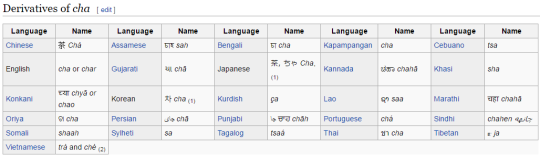
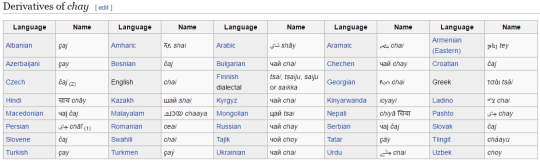
Also, specifically with the chai/tea thing, many languages either use the Malay root and end up with a word that sounds like “tea” (like té in Spanish), or they use the Mandarin root and end up with a word that sounds like “chai” (like cha in Portuguese).
So, can we all stop making fun of this now?
Okay and I’m totally going to jump in here about tea because it’s cool. Ever wonder why some languages call tea “chai” or “cha” and others call it “tea” or “the”?
It literally all depends on which parts of China (or, more specifically, what Chinese) those cultures got their tea from, and who in turn they sold their tea to.
The Portuguese imported tea from the Southern provinces through Macau, so they called tea “cha” because in Cantonese it’s “cha”. The Dutch got tea from Fujian, where Min Chinese was more heavily spoken so it’s “thee” coming from “te”. And because the Dutch sold tea to so much of Europe, that proliferated the “te” pronunciation to France (”the”), English (”tea”) etc, even though the vast majority of Chinese people speak dialects that pronounce it “cha” (by which I mean Mandarin and Cantonese which accounts for a lot of the people who speak Chinese even though they aren’t the only dialects).
And “chai”/”chay” comes from the Persian pronunciation who got it from the Northern Chinese who then brought it all over Central Asia and became chai.




 Rex's place